
International Day of Women and Girls in Science – a chance to shine a light on the scientists at Unity Health Toronto who are breaking barriers in women’s health
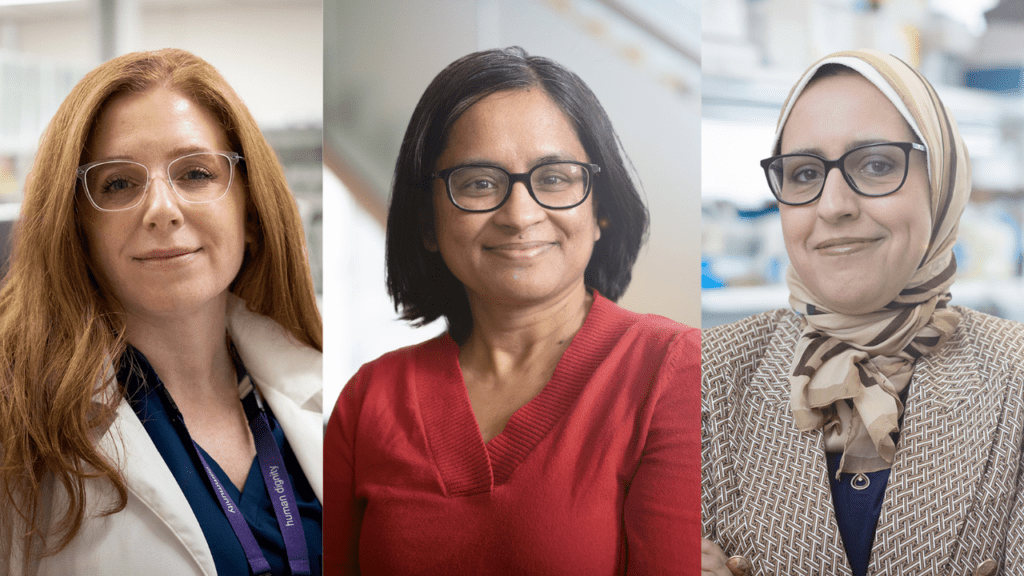
As the global community marks International Day of Women and Girls in Science, Unity Health Toronto is highlighting three researchers who are leading impactful work and making new discoveries around women’s health.
According to the United Nations General Assembly, as of 2022, women made up just 31.1 per cent of researchers, underscoring persistent gender gaps across the field. In a world where the health of women is historically under-researched, these female scientists are pioneering advancement in women’s health care, in Canada and globally, and finding ways to make women healthier and safer overall.
These women represent just a fraction of a much larger community of female scientists at Unity Health Toronto who continue to promote gender equality in the field of medical research. Through their leadership, our women scientists can help to show young girls that rewarding careers in science are achievable.
We asked Drs. Sharmistha Mishra, Michelle Sholzberg, and Hagar Labouta what inspires them as they work to push boundaries in their fields. And each of their answers reflects their own passion: to celebrate the female researchers who came before them, give a voice to those who are often ignored, and keep women safe when faced with medical challenges.
Dr. Sharmistha MishraEnjoying this story? Sign up for the Unity Health Toronto newsletter, a monthly update on the latest news, stories, patient voices and research emailed directly to subscribers.
Dr. Sharmistha Mishra, clinician-scientist at MAP Centre for Urban Health Solutions at St. Michael’s Hospital, uses mathematical modeling and data to study epidemics of HIV and sexually transmitted infections in Canada and with partners in the Global South. Her research helps to address the sexual health needs of communities that are disproportionately affected, including women in sex work.
“I’m inspired by the ‘giants’ who came before us; I love reading foundational papers that make me rethink our current work. I’m also inspired by our research group—my favorite time of the week is our lab meeting, where our team tries to understand the ‘why’ behind our results.”
Dr. Michelle SholzbergDr. Michelle Sholzberg, Division Head of Hematology Oncology and Medical Director of the Coagulation Laboratory at St. Michael’s Hospital, is leading a research team that identifies knowledge and care gaps for women with excessive bleeding and iron deficiency. The team focuses on identifying opportunities for advancing care and making research around women’s health a greater priority in Canada and beyond.
“My patients directly inspire my research and help me identify places where we need to do better. I’m inspired by women and girls who have experienced difficulty accessing medical care – especially for issues that are considered taboo or inappropriately normalized. I want to clarify and to make it easier for healthcare providers to do what’s right.”
Dr. Hagar LaboutaDr. Hagar Labouta, Professor at the Keenan Research Centre for Biomedical Science at St. Michael’s Hospital, is pioneering work in nanomedicine and its potential to revolutionize women’s health. Her research focuses on using specialized particles (nanoparticles) to deliver medication to exact tissues or cells in the body, which minimizes harmful side effects for pregnant patients and their developing babies.
“I want to change the stereotype of what a scientist is, especially when we talk about women in science who are also a visible minority. If the next generation sees a leader in this field who doesn’t fit the traditional idea of a scientist, it can motivate them to pursue a career in science and research.”
By Christine Davidson
Photos by Kevin Van Paassen