Empowering Canada’s health leaders for the AI era: The Health AI Academy takes learning coast-to-coast
Unity Health Toronto’s Data Science and Advanced Analytics (DSAA) team is delivering Artificial Intelligence (AI) education and literacy directly to health care professionals across the country through the Health AI Academy.
The Academy, created with KPMG and Signal 1 and with funding from DIGITAL, completed its inaugural run in November, sending its first cohort of participants off with new insights and ideas about developing and deploying AI solutions in their home organizations.
Damian Jankowicz, Executive Vice President, Chief Information and AI Officer at Unity Health, says the Academy is an opportunity to equip the Canadian health care system with the tools it needs to shape the future of care for patients and their families.
“It’s about building our national capacity,” says Jankowicz. “We’re helping Canadians move towards confident and responsible adoption of AI tools and solutions.”
The two-part course is a national training program for health care leaders, staff and clinicians across Canada, created with the goal of strengthening health system leadership and understanding of AI.
Hundreds of participants tuned in to weekly virtual sessions during the first part of the course, Health AI Foundations, to learn about topics ranging from change management to data governance and AI solution procurement.
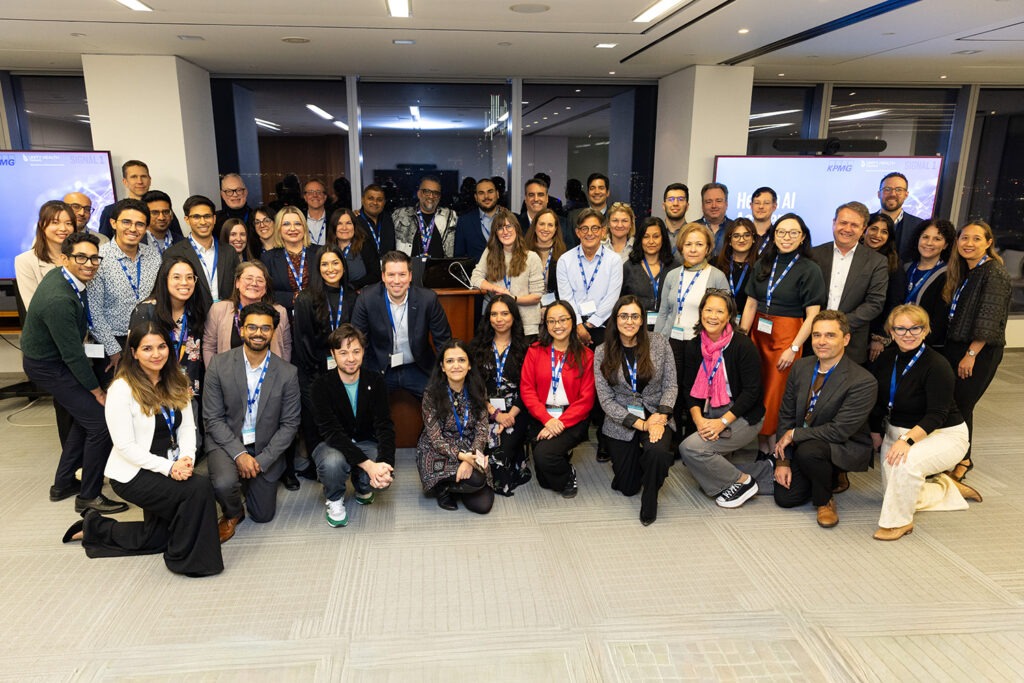
The second phase of the course, the Health AI Fellowship, saw a small cohort of health care leaders visit St. Michael’s Hospital for a week-long in-person program to gain deeper practical knowledge.
Ron Johnson, Vice President, Digital Health, Innovation & Research and Chief Information Officer at Newfoundland and Labrador Health Services, participated in both the Foundations and Fellowship programs.
“This is going to be a catalyst across the country,” Johnson said during a reflection at the Fellowship graduation ceremony. “It will have a multiplying effect.”
For Danina Kapetanovic, Vice President Innovation at Waterloo Regional Health Network and Chief Health Innovation Officer at University of Waterloo, the Foundations and Fellowship programs gave participants “the vocabulary to make sense of a topic that can feel abstract.”
“The Fellowship marks the first wave of leaders who will ensure that as healthcare becomes more intelligent, it also becomes more human,” says Kapetanovic. “AI readiness is as much about wisdom as it is about knowledge.”
Enjoying this story? Sign up for the Unity Health Toronto newsletter, a monthly update on the latest news, stories, patient voices and research emailed directly to subscribers.
The approval and use of AI devices and solutions in health care has increased exponentially in recent years, and the market for these technologies is on a steep incline.
According to KPMG’s 2025 global report, Canada ranks 44th out of 47 countries in AI training and literacy, highlighting a critical gap in preparing the workforce for the future of care. The Health AI Academy was created to bridge this divide by equipping health professionals with the knowledge and skills to evaluate, adopt, and implement AI responsibly. By blending practical training with real-world application, the academy is helping health professionals build confidence in health AI adoption while fostering a national community of more than 200 professionals who are learning, sharing, and growing together.
“The Health AI Academy is more than a training program, it’s designed to empower Canada’s health professionals in a time of rapid change” says Shripal Doshi, Partner, Healthcare and Life Sciences at KPMG.
“We’re proud to collaborate with Unity Health Toronto and KPMG Canada on the Health AI Academy to help equip healthcare leaders with the skills and confidence to adopt AI responsibly,” says Mara Lederman, Co-Founder and Chief Operating Officer of Signal 1. “Education and engagement are essential to closing the AI literacy gap and ensuring that innovation translates into safer, more effective care.”
Unity Health’s DSAA team is uniquely positioned to lead this work. The network leads the country in applied healthcare AI, with 50+ tools developed and tested at our sites to enhance operational decision-making, reduce wait times, customize treatments, improve health outcomes and save lives.
One of these tools is CHARTWatch, the artificial intelligence early warning system developed at St. Michael’s Hospital that monitors hospitalized patients in real-time and identifies those at high risk of unexpected death or transfer to an intensive care unit and sends alerts so that doctors and nurses can intervene early. A study in the Canadian Medical Association Journal shows a 26 per cent reduction in unanticipated mortality after the tool was implemented on the St. Michael’s general internal medicine ward.
Another is Autoscribe, an AI-powered scribe that can generate notes for physicians to review, approve and add to the electronic patient record after a patient visit. AI scribes have been shown to reduce the time spent on this task by an average of 3 to 4 hours a week.
These solutions show that AI can be a transformative tool for staff, physicians and, most importantly, patients across every aspect of health care.
To learn more about the Health AI academy visit our webpage.
By Olivia Lavery
Photo by Katie Cooper