
Family, caregiver and visitor guidance at the Houses of Providence
Infection Prevention and Control
Visitors, caregivers, and family members play an important role in helping to prevent the spread of infection and to keep outbreaks short if/when they occur.
Key ways you can do your part
Even if symptoms are mild, it is safer to postpone your visit for when you’re fully recovered. Learn about the symptoms in the poster below to screen yourself for before visiting.
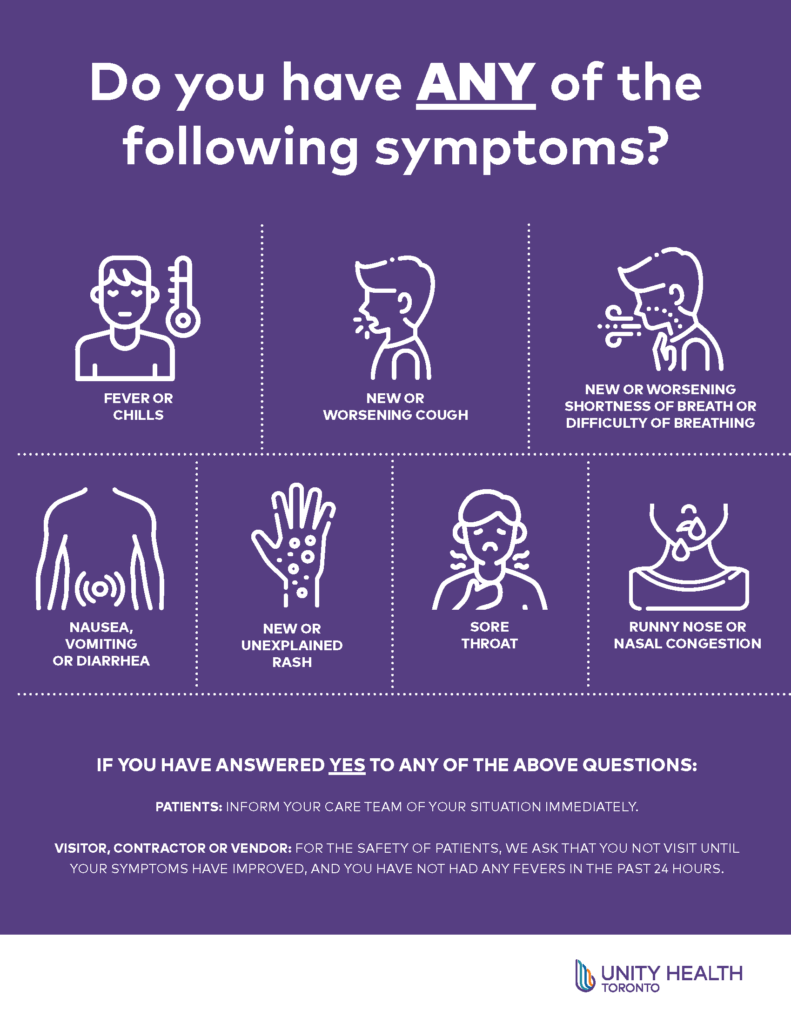
If you have a lingering cough from a previous illness, or sneezing due to allergies, wear a mask to cover the spread of droplets. Read these tips on respiratory etiquette by Public Health Ontario.
During the Fall/Winter months, when respiratory viruses circulate widely, we ask all those entering a resident care or activity area to wear a mask. More information on our masking guidelines is shared below.
We all know to clean our hands, if they look/feel dirty, before eating, after using the washroom or blowing your nose/coughing/sneezing. Using hand sanitizer is the quickest and most effective way to perform hand hygiene. If your hands have been contaminated with body fluids wash your hands with soap and water.
Key moments to clean your hands
| Residents | Families, Caregivers and Visitors |
|---|---|
| Before/After eating or drinking |
Upon entry/exit of the facility, a resident room, or common area |
| Before/after group activities | Before and after providing hands-on care |
| After toileting | Before putting on and after taking off gloves |
| When hands are visibly soiled | After touching potentially contaminated or shared items |
See below for more information about our fall vaccination campaign.
Use of Personal Protective Equipment
Whenever there is a risk of body-fluid exposure to either your clothes, hands, face, or eyes (when providing direct care to a resident), you will need to use personal protective equipment (PPE) to protect yourself. PPE can include a gown, gloves, mask or face shield.
When you select PPE based on the potential of exposure to body fluid(s), it is known as a point-of-care risk assessment (PCRA).
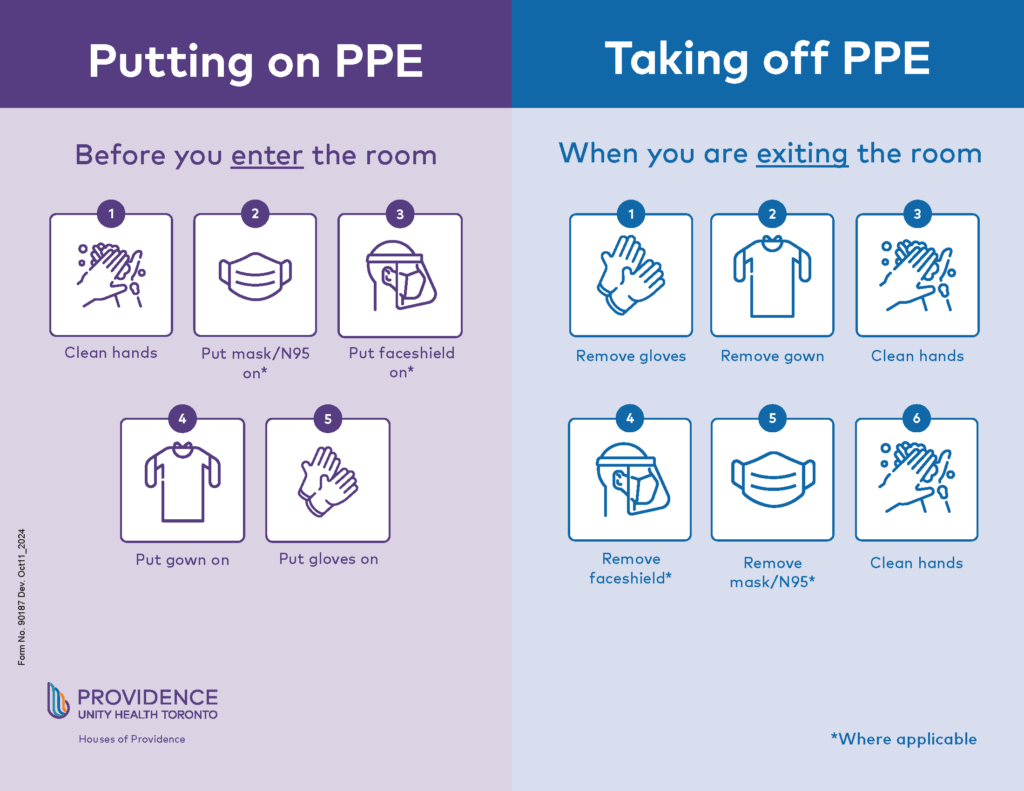
When residents are on precautions, PPE is also required when providing direct care. See sections on contact precautions and droplet + contact precautions. When putting-on and taking-off PPE, it’s important to take the time to do so carefully.
Following the correct steps for putting on (donning) and taking off (doffing) PPE protects you from inadvertent self-exposure. When a resident is on precautions, signage-as the one shown below-will be posted outside the resident room to help guide you on how to safely put on and take off personal protective equipment (PPE).
Always ask a staff member for assistance if you need to gain access to PPE or have any questions.
 Examples of “hands-on” care:
- bathing,
- washing,
- turning the resident,
- changing clothing,
- continence care,
- dressing changes,
- care of open wounds/lesions,
- toileting.
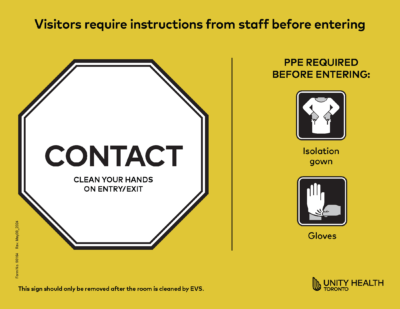
If a resident is on contact precautions, you will see a yellow or green sign on the resident door. There will also be a clean PPE cart outside the room.
A yellow gown and gloves must be worn when providing ‘hands-on’ care
Additional PPE should be selected based on other factors such as respiratory season, outbreak status on the unit, and risk of exposure to body fluids to the face and eyes.
Upon room exit, follow the steps for ‘taking off PPE. You must dispose your gloves in the waste receptacle and the gown in the used linen hamper positioned outside the room.
Always clean your hands with the facility-provided alcohol based hand sanitizer based on the steps outlined in the posted signage.
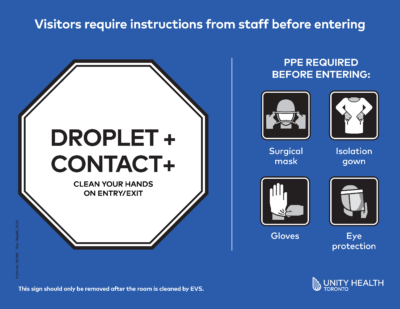 A mask must be worn when entering a room on droplet contact precautions.
A face shield must be worn if you will be within 2 meters (6ft.) of the resident.
If a resident is on droplet + contact precautions, you will see a blue sign on the resident door and a clean PPE cart outside their room.
A yellow gown, and gloves must be worn when providing ‘hands-on’ care.
Examples of “hands-on” care:
- bathing,
- washing,
- turning the resident,
- changing clothing,
- continence care,
- dressing changes,
- care of open wounds/lesions,
- toileting
Upon room exit, follow the steps for taking off PPE. You must dispose your gloves, face shield and mask in the waste receptacle and the gown in the used linen hamper outside the room.
Always clean your hands with the facility-provided alcohol based hand sanitizer based on the steps outlined in the posted signage.
Please see the table ‘Key Moments to Clean Your Hands’ for guidance on when visitors are required to clean their hands.
When transporting or accompanying a resident on droplet + contact precautions outside of their room, the visitor should wear a mask. If tolerated, the resident should also wear a mask.
Efforts to maintain physical distance from other residents and visitors are key to preventing transmission when transporting or accompanying a resident outside of their room.
We always balance the IPAC risks to individual residents with their overall well-being.
There is flexibility for visitors and family members on compassionate grounds when it comes to PPE requirements. In these situations, IPAC will provide tailored guidance to family and visitors on a case-by-case basis.
Masking requirements are subject to change depending on virus activity in the Houses and community and so we will communicate any changes to residents and families as COVID-19 and other respiratory virus transmission decreases.
Visiting during outbreaks
Where possible, we ask general visitors to postpone visits after an outbreak resolves. There are no visitation restrictions for essential caregivers, however, any required PPE instructions and hand hygiene practices should be followed (see contact precautions and droplet contact precautions).
As always, masks will be required for entry to a unit on respiratory outbreaks including flu, RSV, and COVID-19. See information above on visiting during outbreaks.
When there is an outbreak, the ‘Outbreak Alert’ sign will be posted at key locations.
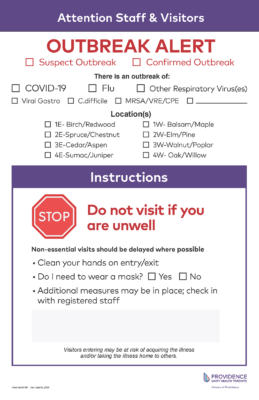 Central group activities (events with residents participating from different Houses) are usually paused during a respiratory or gastrointestinal outbreak. When an outbreak affects many residents on a unit, local group activities in the affected House itself may also be paused until the outbreak is more well-controlled.
Essential caregivers can still interact with residents one-on-one and even leave their room or care area together as long as masking, hand hygiene and physical distancing practices can be followed.
Masks are available year-around at the main entrance and on each House. Every year, starting in October or November, we ask all visitors, family members, and caregivers to wear a mask when interacting with residents of the Houses of Providence.
The flu, RSV and COVID-19 circulate more widely between the fall and winter months and can spread from person-to-person even before symptoms start. Wearing a mask during your visit helps to protect our residents who are more vulnerable to serious illness.
There are some scenarios when we encourage residents to wear a mask if it is feasible to do so.
Some examples for residents to wear a mask may include:
- Based on the resident’s preference
- In common areas when their unit is on outbreak
- When a resident on droplet contact precautions needs to leave their room.
Please note: Reasons for being on droplet contact precautions can vary and does not necessarily mean that the resident has active respiratory symptoms or a confirmed respiratory illness.
Please change your mask when exiting a room where a resident is on contact or droplet+ contact precautions. Always remember to clean your hands with alcohol-based hand sanitizer before putting on a mask and after removing it.
Good hand hygiene becomes even more important during the respiratory season in fall/winter months when viruses can be picked-up from surfaces such as elevator buttons, door handles, tables and chairs. Using hand sanitizer is the quickest and most effective way to stop the spread.
Vaccine and disease information
We offer annual vaccination for influenza and bi-annual vaccination against COVID-19. Residents who have not yet received it, are also offered the RSV vaccine.
We regularly review vaccine consent statuses for all residents. Where applicable, connect with residents or their power of attorney (POA) to obtain consent.
To learn more click below:
COVID‑19 vaccines | ontario.ca
Older adult high-risk respiratory syncytial virus (RSV) vaccine program fact sheet
Last updated February 04, 2026